 Visit veterinary professionals site
Provide Your Horses Valuable Protection From Costly Summer Sores
Read Article
Kenton Morgan, DVM, Equine Technical Services Veterinarian, Zoetis
4/25/2023
Flies are more than a nuisance—these insects can transmit diseases, cause bacterial infections and trigger equine allergic dermatitis. They also leave behind parasitic larvae that can fester into painful, difficult-to-treat summer sores (cutaneous habronemiasis).
Developing an effective fly control plan to prevent these nonhealing wounds begins with understanding which fly species to target, how they reproduce and how they can irritate your horse. Plus, there’s an added benefit—proactively reducing fly populations that cause summer sores can help prevent other diseases they carry too.
Know your fly populations
House flies and stable flies share similarities: They look alike and can be linked to the spread of strangles, equine influenza, Salmonella, summer sores, vesicular stomatitis, E. coli, pigeon fever, and equine dermatitis (Onchocerca) and equine infectious anemia. The females of both species lay eggs in decaying organic material like rotting hay, bedding and leaves.
These insects are distinguished by their mouthparts:
What causes summer sores?
Despite their differences, both species can deposit infective larvae of the equine stomach worm (Habronema muscae) or (Habronema microstoma) in open wounds or around moist areas while feeding on your horse. These larvae can then trigger severe itchiness, inflammation and ulceration around the affected site. Proud flesh or granulomatous tissue commonly develops, causing a chronic wound condition that’s difficult to heal.1
Summer sores rarely heal on their own and are challenging to treat. Call your veterinarian as soon as you notice minor lacerations that don’t heal quickly or if you see any abnormal lesions on your horse.
The fly lifecycle
Horses pick up equine stomach worm larvae from their feeding activities and then, once ingested, they mature into adults in the stomach of the horse. Once mature, the adult worms lay eggs. Those eggs are shed into the environment in your horse’s manure, where flies feed on the hatched larvae.1
Take preventive steps today
Getting a head start on fly season can help provide the most effective control to prevent immature flies from developing into adults. Flies begin to emerge once temperatures rise above 50 F, so depending on where you live, that could be between February and April. In mild climates, house and stable flies breed year-round, with peak populations occurring during humid months.
Select a dewormer with your veterinarian
The American Association of Equine Practitioners recommends making deworming decisions based on your horse’s age, egg shedding levels and the length of the grazing season in your area. Learn more in this blog titled, “Stay ahead of parasites with targeted deworming.”
Deworming your horse at the beginning of the grazing season is also an important component in reducing stomach worm populations. Moxidectin, the active ingredient in Quest® Gel (moxidectin) and Quest® Plus Gel (moxidectin/praziquantel) dewormers, works to kill stomach worms that produce eggs capable of developing into larvae and eventually contributing to the development of summer sores.2
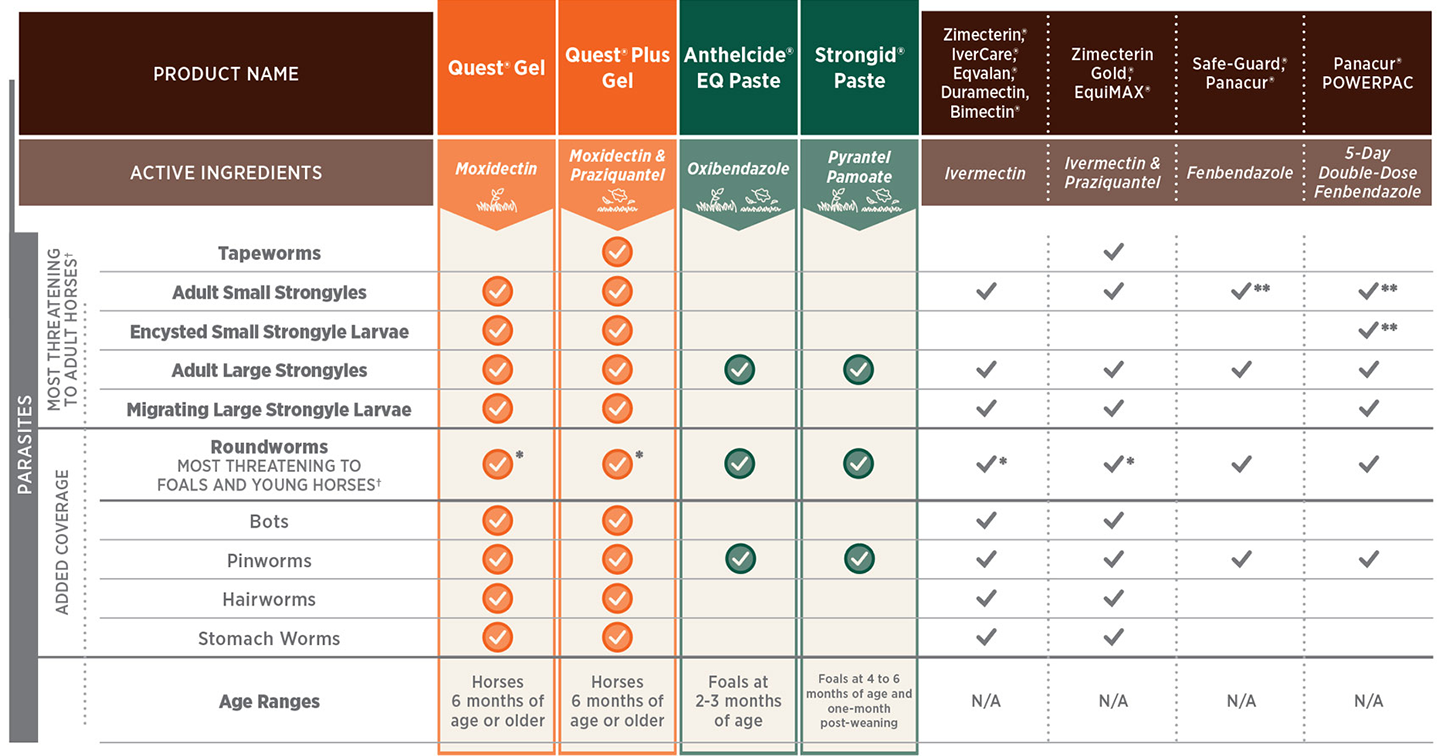 *Per the 2019 AAEP Parasite Control Guidelines, there is widespread roundworm (ascarid) resistance (lack of efficacy) to macrocyclic lactones (moxidectin and ivermectin).
**Per the 2019 AAEP Parasite Control Guidelines, multiple studies show widespread small strongyle (cyathostomin) resistance (lack of efficacy) to benzimidazoles (fenbendazole and oxibendazole).
A nod to good horsekeeping
Breaking the fly lifecycle begins with good horsekeeping practices. In addition to using a feedthrough product such as Solitude IGR and deworming your horse, be sure to:
Schedule a call with your veterinarian
Involving your veterinarian sooner rather than later is essential to treating summer sores using the least invasive protocols. What looks like a minor wound can trigger an inflammatory reaction that spirals out of control, becoming a nonhealing wound that lingers or worsens over time.
Do not use Quest Gel or Quest Plus Gel in foals less than 6 months of age or in sick, debilitated and underweight horses. Do not use these products in other animal species, as severe adverse reactions, including fatalities in dogs, may result. Consult your veterinarian for assistance in the diagnosis, treatment, and control of parasitism.
Read Article
Read Article
Read Article
References
All trademarks are the property of Zoetis Services LLC or a related company or a licensor unless otherwise noted. Bimectin is a trademark of Bimeda Inc. EquiMAX is a trademark of Virbac. IverCare is a trademark of Farnam. Panacur is a trademark of Merck Animal Health. Safe-Guard is a trademark of Intervet Inc. Zimecterin Gold and Eqvalan are trademarks of Boehringer Ingelheim. © 2023 Zoetis Services LLC. All rights reserved. SOL-00037R1
Share this article


